
Fresh off our meetings at NRF ’26, one thing is certain: the conversation has shifted from “What is an AI agent?” to “How do I wire my business into one?”.
If our last article was the “why,” this is the “how.” For brands looking at the Universal Commerce Protocol (UCP), the transformation isn’t just a marketing layer – it’s a fundamental change to your operational, development, and revenue models.
The “Engine Room”: How UCP Actually Works
UCP isn’t a closed black box; it’s a layered, open standard co-developed by Shopify and Google. Think of it like the “HTTP of shopping”.
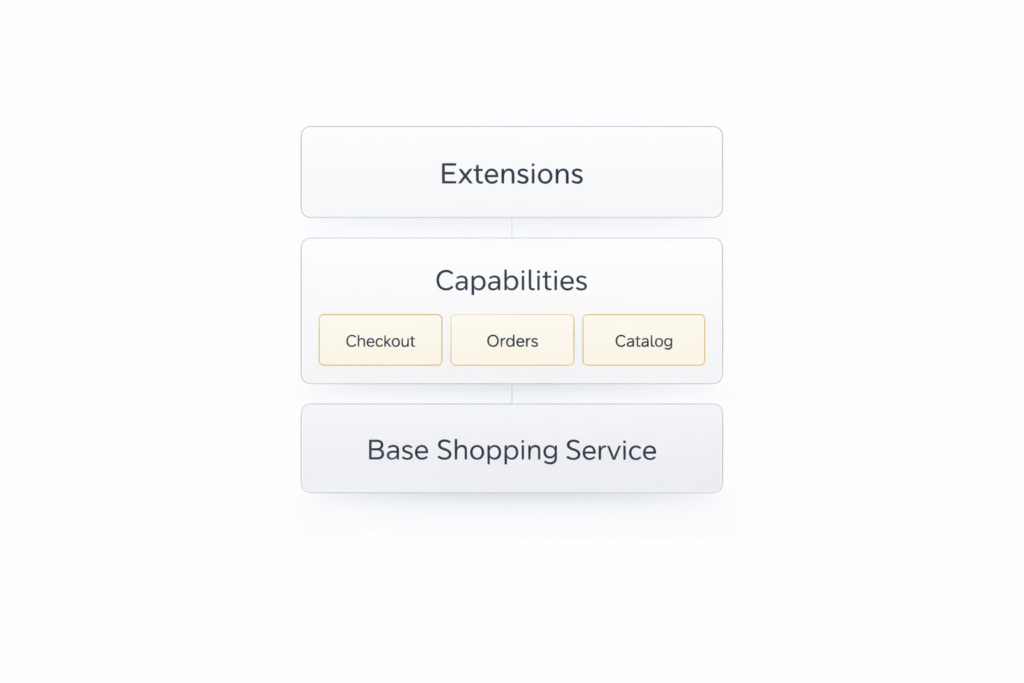
1. The Architectural Layers
- Base Shopping Service: The foundation that defines “primitives” like checkout sessions, line items, and totals.
- Capabilities: These are independent modules for major functions like Checkout, Orders, and Catalog.
- Extensions: This is where it gets powerful. Extensions allow you to plug in brand-specific logic, like loyalty points, custom discounts, or specialized fulfillment (e.g., local pickup), without breaking the core protocol.
2. The Development Lift
For developers, UCP is transport-agnostic. It supports classic REST APIs for universal compatibility, but it also uses the Model Context Protocol (MCP), which lets an LLM (like Gemini or ChatGPT) invoke “tools” like create_checkout directly in a chat.
💡Operational Tip: Each merchant publishes a UCP Profile (usually at /.well-known/ucp) that tells agents exactly what capabilities and payment methods you support.
The ROI: 4.4x Conversion Potential
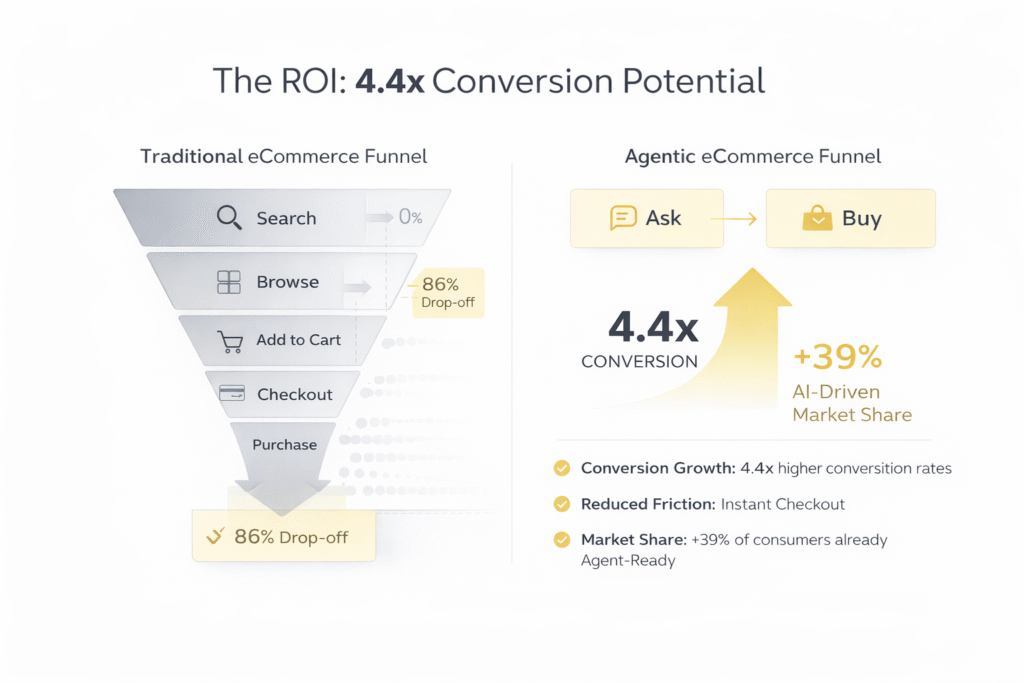
The data coming out of early 2026 pilots is staggering. While traditional search is a “leaky funnel,” agentic commerce collapses the journey.
- Conversion Growth: McKinsey research indicates that AI-generated recommendations can drive 4.4x higher conversion rates compared to traditional search.
- Reduced Friction: By enabling “Instant Checkout” within the LLM, you eliminate the 86% conversion drop-off typically seen when users are redirected from a chat to a website link.
- Market Share: With 39% of consumers (and over 50% of Gen Z) already using AI for discovery, being “Agent-Ready” isn’t about new revenue – it’s about protecting your existing market share as search behavior migrates away from https://www.google.com/search?q=Google.com to “AI Mode”.
Operational Playbook: What Your Team Needs to Do
For the Marketing Team: Clean Your Data
In this new world, Product Data is your new SEO. AI agents don’t care about “catchy” titles; they care about Structured Attributes.
- Ensure your descriptions include use cases, materials, and specific constraints (e.g., “fits small kitchens,” “waterproof up to 10m”).
- If an agent can’t “read” why your product is better, it won’t recommend it in a comparison.
For the Operations Team: Real-Time Everything
AI agents check real-time inventory before recommending a product. If your stock levels drift or your shipping windows are vague, the agent will simply skip your brand for a competitor who provides a “guaranteed” answer.
For the Leadership: The “Agentic Plan” Edge
Even if you aren’t on Shopify, you can use their Agentic Plan to access the Shopify Catalog – a massive discovery engine that syndicates your data to ChatGPT, Copilot, and Gemini. This allows you to treat Shopify as an “AI Distribution OS” while keeping your existing backend.
Final Thought: The “Webless Web”
At NRF ’26, Shopify’s CEO Tobi Lütke made it clear: they want to make every store “agent-ready by default”. We are entering the era of the “Webless Web,” where your website is no longer the destination – it’s the warehouse, and the AI agent is the storefront.
At SnapTec, we’re already helping brands map their complex checkout logic into UCP-compliant schemas. The goal isn’t just to be “on AI” – it’s to be the brand the AI prefers to sell.
Is your product data ready for an LLM to read it?